 eBay Calculator
The per-order fee: why cheap items cost more to sell on eBay
Most eBay fees are a percentage of the sale, so they grow and shrink with the price. One is not. Business sellers pay a fixed fee on every order: 30p when the order total is £10 or less, and 40p above that. If you are not VAT registered, VAT makes that 36p and 48p.
On a £200 order the fee is invisible. On a £5 order it is not.
Selling a £5 book
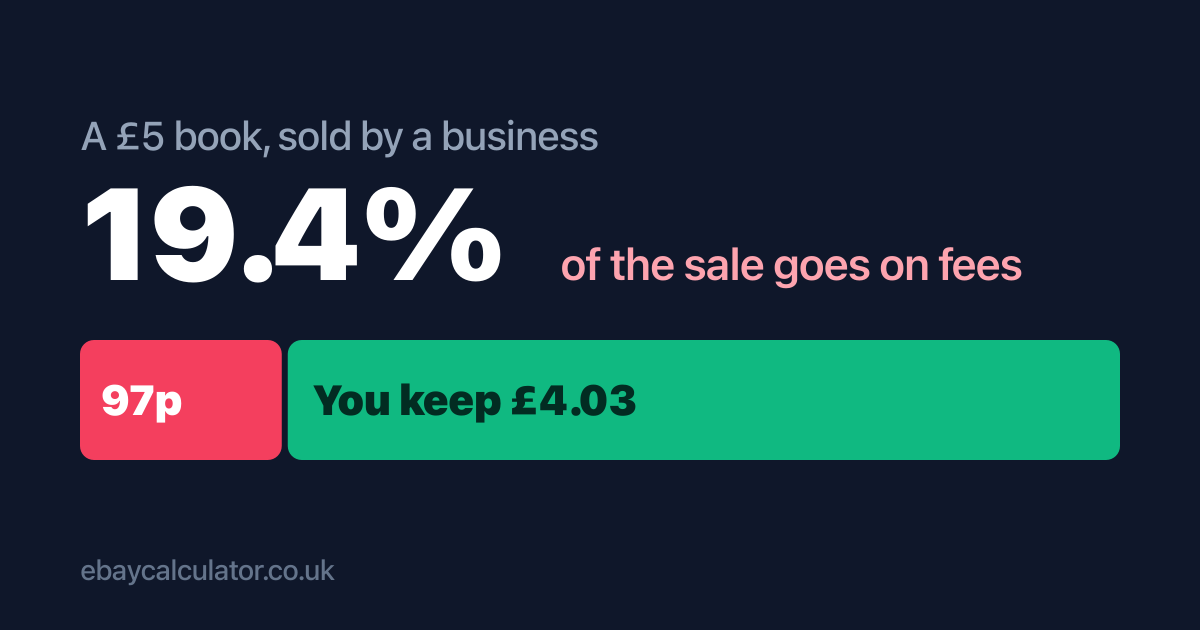
Here is a £5 book in Books, Comics & Magazines, sold by a business that is not VAT registered, with no postage charged:
| Fee | Amount (including VAT) |
|---|---|
| Final value fee (9.9%) | £0.59 |
| Per-order fee | £0.36 |
| Regulatory operating fee | £0.02 |
| Total fees | £0.97 |
That is 19.4% of the sale price, nearly double the 9.9% headline rate. You keep £4.03 before you have paid for the book or the stamp.
The price jump at £10
The order total includes postage. Once it goes above £10 the per-order fee rises from 30p to 40p:
| Sold price | Total fees (including VAT) | Left over |
|---|---|---|
| £10.00 | £1.59 | £8.41 |
| £10.01 | £1.71 | £8.30 |
An extra penny costs you 11p. It is a small amount, but it is worth knowing when you set a price around £10, or when you decide whether to charge for postage.
What you can do
- Sell cheap items together. One order of three £5 items pays the per-order fee once, not three times. Offer combined postage and multi-buy discounts.
- Check the break-even price first. Put your purchase price and postage cost into the calculator and see what you need to charge. Our guide to pricing to break even shows how.
- Think about whether low-value items are worth it. If your profit on a £5 item is under £1, the time to list and pack it may not pay.
Some categories have a reduced per-order fee. The calculator does not model that yet, so for those categories it can slightly overstate your costs.