 eBay Calculator
Trading cards over £250 on eBay: authentication and fees
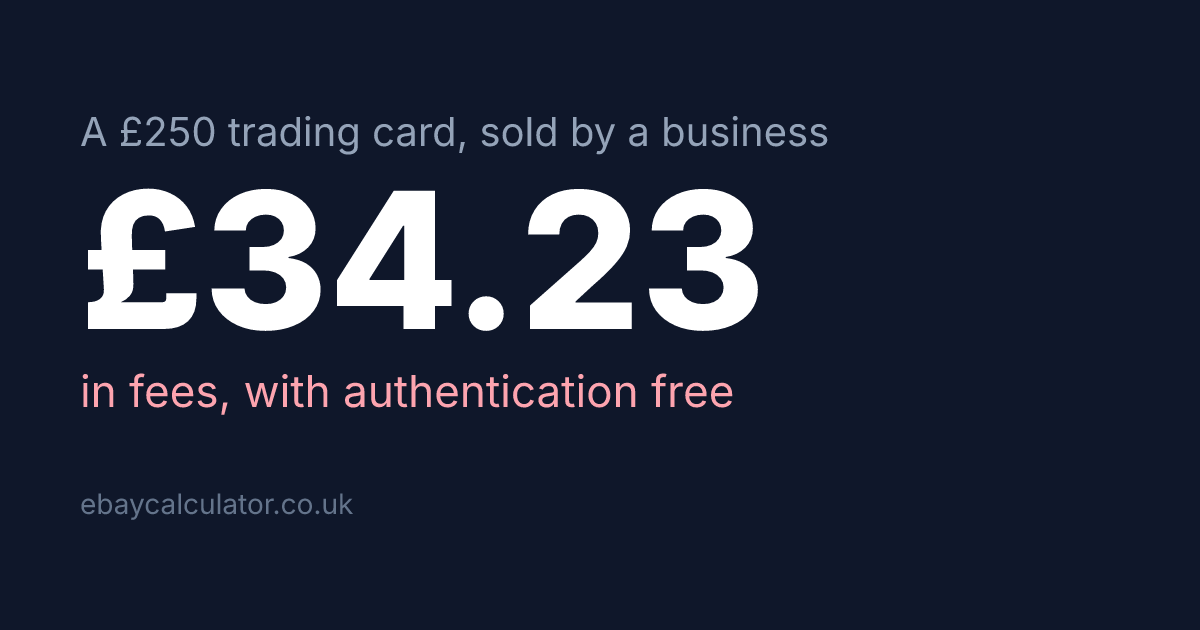
eBay UK's October Seller News says Authenticity Guarantee for trading cards is expanding to cover cards valued at £250 or more. It doesn't give a date for the change, but eBay's Authenticity Guarantee page already uses the £250 threshold. When the scheme launched in the UK in May, it only covered cards at £500 and above. So if you sell cards in the £250 to £499 range, some of your sales will now go through an independent authenticator before they reach the buyer.
Which cards are covered
According to eBay's trading card Authenticity Guarantee page, a card qualifies if all of these apply:
- It's listed in Collectable Card Games, Sports Trading Cards or Non-Sports Trading Cards
- It's a single card, graded or ungraded. Graded cards must come from PSA, SGC, CGC Trading Cards, CSG or BGS
- It's priced at £250 or more, not counting postage, as a fixed price or auction listing
- It's going to a UK address
Sets, lots, kits, decks, boxes, packs of two or more cards, art cards and redemption cards are excluded. So are miscategorised listings, orders paid offline, orders the buyer collects in person and orders sent to a PO box. Eligible listings show a blue Authenticity Guarantee badge.
For eligible cards, sellers can't opt out. eBay's terms say that by listing an eligible card, you agree to send it to the authenticator when it sells. Buyers can't skip it either: eBay says that at £250 or more, authentication can't be bypassed.
What changes when the card sells
You don't post the card to the buyer. You send it to a UK authentication facility that eBay tells you about. PSA is the authenticator. It checks the card against your listing: corners, edges and surface for raw cards, or the holder and label for slabbed cards. It doesn't grade or re-grade.
The terms set out some practical rules:
- Each card must be posted to the facility on its own, and you can't drop it off in person
- You pay the postage to the facility. eBay doesn't cover it
- eBay pays for authentication and for the tracked delivery from the facility to the buyer
- If PSA can't verify the card, or finds it doesn't match the listing, the buyer gets a full refund. For a PSA slab that turns out to be fake or tampered with, PSA deactivates its certificate and notifies the seller
- eBay gives no deadline for posting to the facility. The terms also don't say who carries the risk while the card is on its way there: eBay only takes on the risk from the facility to the buyer, and for cards lost or damaged at the facility
- Buyers can cancel within an hour of buying if you haven't posted the card yet. For cards of £500 or more, the buyer has to give a 4-digit PIN to the DPD driver on delivery
Returns also go through the facility. If you accept returns, or the buyer claims the card isn't as described, the card goes back to PSA first for a check. Postage to the facility is paid by the seller or the buyer, depending on the listing. eBay pays to send the card on to you. If the card isn't the one you sent, isn't in the same condition, or its tamper seal has been removed, it goes back to the buyer and the return is closed.
What it costs: the fees don't change
Authentication is free for sellers at £250 and up, and eBay's selling fees work the same as for any other sale. The difference is the cost and time of posting to the facility.
Private sellers
eBay's private seller fee page says selling is free for UK-based private sellers, apart from vehicles. You pay no final value fee and no regulatory operating fee. Authentication only applies to UK buyers, so the international fee never comes into it. A private seller selling a £250 card through the scheme pays eBay nothing, unless they've bought optional listing upgrades or gone over their free listings for the month. Their only extra cost is the postage to the facility.
Business sellers
The only trading card categories with their own rate in eBay's business fee table are the NFT subcategories, at 5%. Physical cards pay their parent category's rate. On eBay's table, Collectables, Sports Memorabilia and Toys & Games are all 10.9%. On top of that comes the regulatory operating fee of 0.35% and a per-order fee of £0.40 for orders over £10. All of these are charged on the total sale, including any postage the buyer pays, and all are shown without VAT.
Take a £250 card with free postage, sold by a business seller:
| Not VAT-registered (VAT on fees included) | VAT-registered | |
|---|---|---|
| Final value fee (10.9%) | £32.70 | £27.25 |
| Per-order fee | £0.48 | £0.40 |
| Regulatory operating fee (0.35%) | £1.05 | £0.88 |
| Total fees | £34.23 | £28.53 |
| You receive before costs | £215.77 | £221.47 |
A Top Rated seller who isn't VAT-registered gets 10% off the variable part of the final value fee, so total fees fall to £30.96. The per-order fee is not discounted.
Now compare a card priced at £249.99. With the same settings it sits just outside the scheme, and the fees still come to £34.23. The 1p difference rounds away. Pricing just under £250 doesn't save you anything on fees. It only decides whether the card goes through authentication.
For VAT-registered sellers, the table leaves out any VAT due on the sale itself. That depends on your circumstances. HMRC's guidance is the place to check.
Is it worth pricing at £249.99 to avoid it?
That's a judgement call, and it isn't about fees. Here's what to weigh:
- Against authentication: you pay to post to the facility, delivery takes longer, and you can't post straight to a buyer who wants the card quickly
- For authentication: buyers see the badge. If a dispute comes up, an independent check has already confirmed what you sent. Returns are checked before the card comes back to you, and a card that isn't the one you sent is rejected
If you sell a lot of cards near the threshold, try both ways and compare sell-through and returns rather than assuming either works better.
What to do now
- Check what you have listed at £250 to £499. Those listings will now go through authentication when they sell, so make sure your photos and condition notes match the card exactly. PSA checks against them.
- Budget for postage to the facility. If you offer free postage, this is a cost you carry. Use a tracked service with cover for the card's full value, because the terms don't say eBay covers that leg.
- Use a single card per listing if you want the badge. Lots and bundles aren't eligible.
- Work out your take-home before you set a price. The calculator gives the fees for your category and seller type. Add the postage to the facility as your postage cost.